The New Senses Concept
When Swiss unveiled the Senses cabin concept alongside the arrival of the Airbus A350 in their fleet, it was framed as a wholesale reinvention — not just of the seat, but of the entire sensory experience of flying SWISS Business Class. New lighting, a revised menu philosophy, a curated fragrance scheme, and a redesigned amenity programme. The promise was a cohesive, considered world that would feel authentically Swiss from the moment you boarded.
The amenity kit was redesigned accordingly, with a clear brief: move away from the traditional approach of cramming as many branded items as possible into a pouch, and instead deliver something more intentional, more sustainable, and more honest about what passengers actually use. Swiss provided this kit for review ahead of the commercial rollout.
The result sits somewhere between minimalist vision and real-world compromise. The concept is right. The execution raises questions that regular Business Class travellers will ask loudly — particularly those accustomed to what the competition is currently offering.
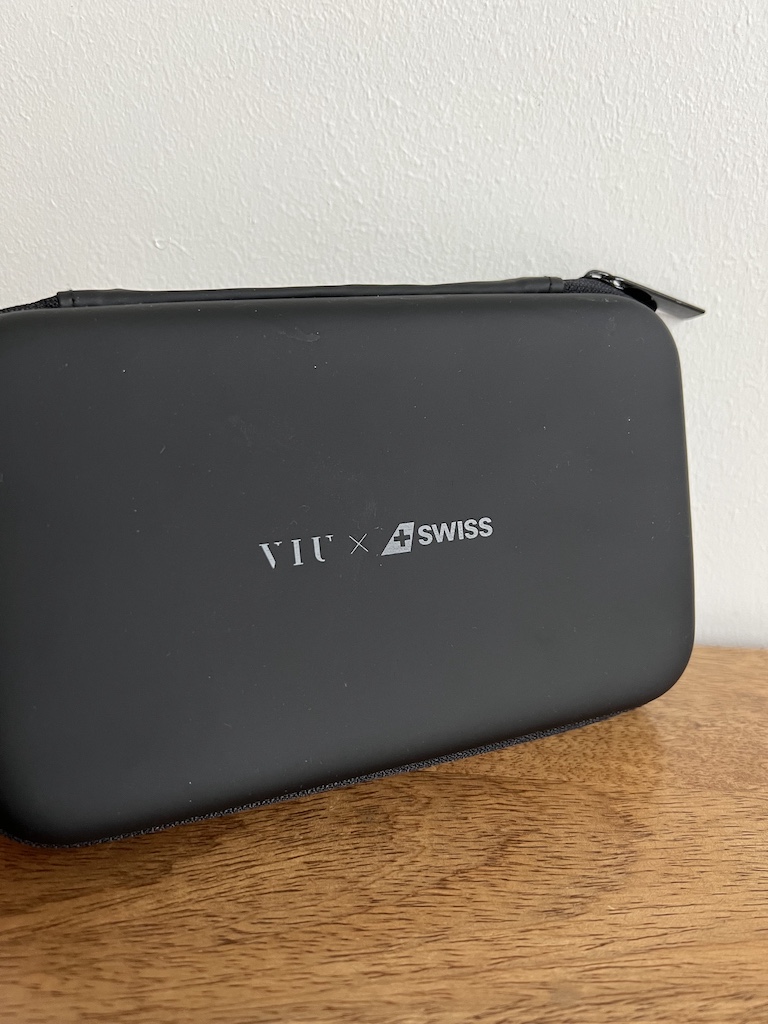
Base Kit Contents
What you find inside the pouch when it is placed on your seat: a toothbrush, a small tube of toothpaste, a pair of socks, and a set of foam earplugs. That is the complete base kit. Four items. Swiss have made no attempt to pad this out with redundant objects, and the positioning is clear — these are the four things most passengers actually use on a long-haul flight, delivered without excess.
This is a considered decision, and in isolation it is not wrong. The toothbrush is decent. The socks are soft, serviceable, not spectacular — they are not the heavy-knit, branded variety that competitors like Singapore Airlines have made something of a signature. The toothpaste is a standard travel-size in an unbranded format. The earplugs are the foam cylinder type; functional and immediately disposable.
The issue is not the quality of what is here. It is the expectation gap. A passenger in Business Class on a premium European carrier, on a transatlantic or ultra-long-haul sector, arriving to find a toothbrush and a pair of socks in their amenity kit will, in many cases, feel that something has been forgotten. That instinct is not irrational. Something has been deliberated away.

On-Request Items
Here is the design twist that Swiss built into the Senses concept: a sleep mask, mouthwash, lip balm, a microfiber glasses cloth, and a comb are all available — but not automatically distributed. They must be requested from the cabin crew.
This is a philosophy borrowed, with some credibility, from Singapore Airlines, who have long operated a similar on-request approach for certain amenity items in premium cabins. The argument is sound: not every passenger wants every item; distributing everything creates waste; on-request means you get exactly what you need and nothing is thrown away unused. Singapore can carry this off because their cabin crew culture and attentiveness make requesting something feel entirely natural.
On Swiss, the approach is more variable. The effectiveness of the on-request system depends entirely on crew awareness and passenger willingness to ask. In practice, many passengers — particularly those who travel frequently and have learned not to rummage through pouch contents mid-flight — will not realise the additional items exist. If you know, you can ask. If you do not, you may land having used only the base kit, with no awareness that a sleep mask was available three rows away.
The concept works better in theory than in practice unless crew proactively mention it at boarding. A simple card in the pouch listing available items would resolve this instantly. There is no such card.
"The on-request model is intelligent in principle. In practice, it was developed by people who don't fly enough to know that most passengers won't ask."LastManBoarding — Swiss Business Class Senses Edition, March 2026
The Bag
The pouch itself is the strongest element of the kit. It is a soft, structured microfiber case in a muted, earthy palette that reads as genuinely Swiss without resorting to logo-heavy branding or red-cross clichés. The material is pleasant to the touch and durable enough to warrant re-use. It closes neatly with a magnetic snap rather than a zip, which feels premium and behaves well.
The proportions are interesting: the pouch is sized and shaped more like a glasses case than a traditional amenity bag. This appears to be entirely intentional. The microfiber cloth included in the on-request items — when combined with the structural rigidity of the pouch itself — makes for a perfectly functional glasses case that most passengers will actually continue using long after the flight. It is the one moment where the Senses concept delivers a genuinely clever, considered object rather than a compromise.
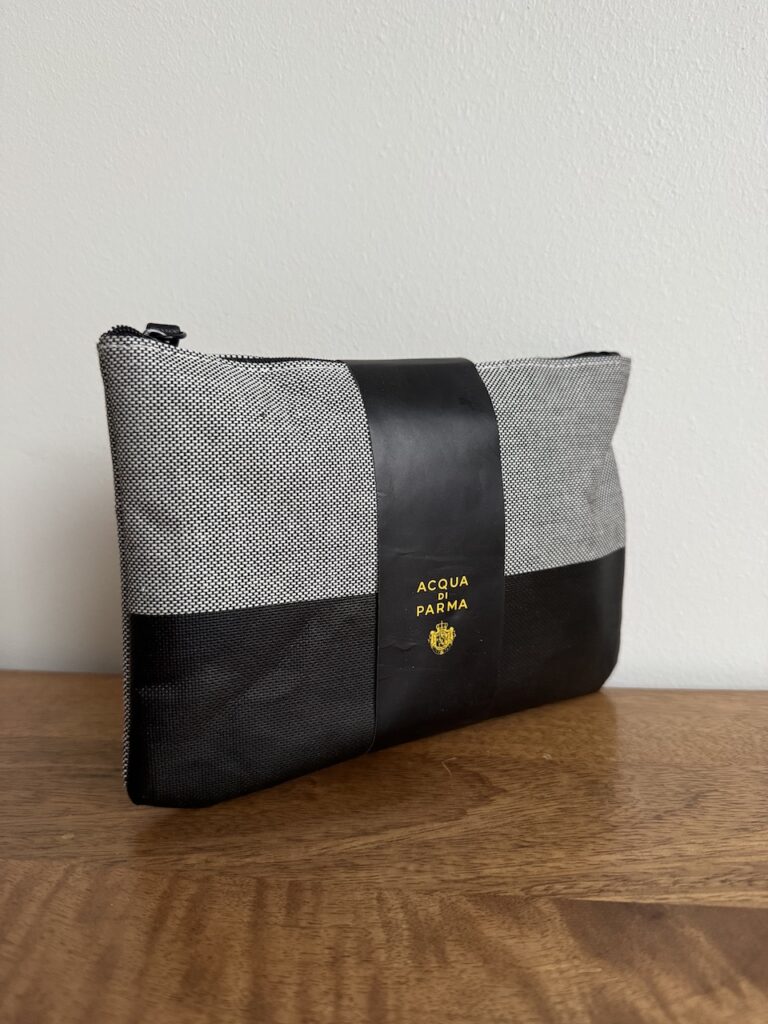
Whether the pouch justifies the overall kit in premium feel terms is a harder question. It is a well-made, discreet object. It does not, however, carry the weight of a kit associated with any recognisable luxury or cosmetics partner. There is no equivalent of the Bulgari seal on an Emirates pouch, or the Acqua di Parma stamp that Air Canada Business Class currently carries.
The Verdict
The Swiss Business Class Senses amenity kit is the product of a well-intentioned brief that reached the right conclusions about waste and sustainability, then stopped short of the execution required to make those conclusions feel like a positive rather than a subtraction. The sustainability credentials are genuine and are not marketing theatre: Swiss has demonstrably reduced single-use plastic, made thoughtful choices about packaging, and built a reuse case into the pouch itself.
But frequent flyers comparing this against the Emirates Business Class kit — generous, branded, fragrant, and packed with items that feel like gifts rather than utilities — or against the Air Canada Acqua di Parma collaboration, which imbues a modest set of contents with the halo of a genuine luxury house, will find the Senses kit falls short on premium feel. It feels like a very good economy-plus kit delivered into a Business Class context.
The on-request model has merit and is not without precedent at serious carriers. Its failure here is primarily communicative: passengers are not told the items exist, and the crew do not consistently volunteer the information. A single printed insert listing the on-request items would cost almost nothing and would solve the core discovery problem entirely.
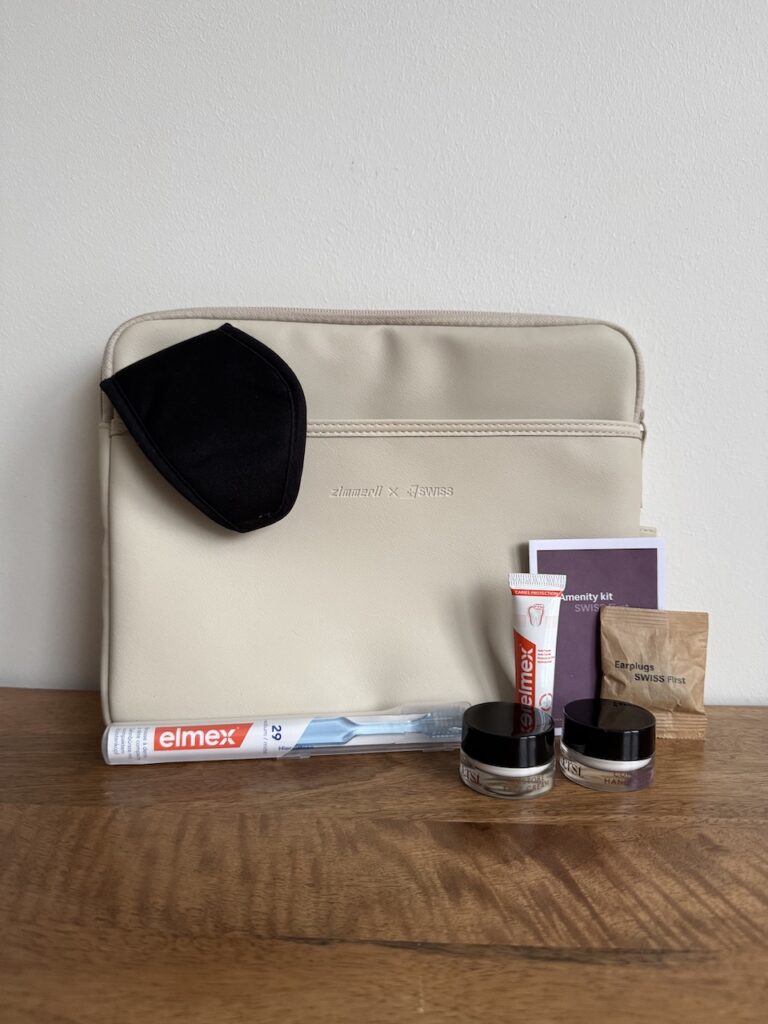
Swiss First Class, meanwhile, continues to carry the Zimmerli partnership as a benchmark for what the airline is capable of when it takes amenity seriously. The distance between the First and Business kits is not just one of budget but of ambition. The Senses concept deserves a Business Class kit that meets it at the same level. This one does not — yet.